
Introduction to GLM 5 AI
Artificial intelligence (AI) is rapidly evolving, and the launch of GLM 5 has created quite a stir in the tech world. Whether you’re a student, developer, content creator, or business professional, understanding GLM-5 AI can help you stay ahead of the curve in adopting new technologies.
Why is GLM 5 AI getting attention
GLM 5 AI has become popular for its ability to understand and generate human-like text with high accuracy. Compared with older AI models, it offers faster response times, multilingual support, and greater versatility across applications.
Who developed GLM 5 AI
GLM 5 is developed by Zhipu AI, a company known for building advanced generative AI models that compete with global leaders like ChatGPT and Claude. Their goal is to create models that are efficient, accurate, and easy for beginners to use.
What is GLM 5 AI
GLM-5 AI is a next-generation generative language model. It’s designed to generate human-like text, answer questions, summarize information, and assist with a variety of tasks across various industries.
Simple explanation of GLM-5
At its core, GLM-5 is trained on a massive dataset that allows it to understand context, nuances, and generate meaningful responses. Unlike earlier AI models, it can handle complex instructions more accurately and in multiple languages.
How GLM-5 works
GLM-5 uses deep learning and transformer architecture to process large amounts of text. It predicts the next word in a sequence while maintaining context, which enables it to generate coherent and contextually accurate sentences.
Key Features of GLM 5 AI
GLM-5 excels in natural language understanding, making it capable of answering questions, summarizing documents, and creating human-like text efficiently.
1️⃣ Massive Mixture-of-Experts Architecture
GLM 5 AI is built on a Mixture-of-Experts (MOE) model, which sets it apart from traditional dense models. Instead of activating all parameters at once, only a subset of “experts” (~40–44 billion parameters) is used for each token, while the total model has 744–745 billion parameters.
This approach provides two major benefits:
- Efficiency: The model uses less computation per token compared to full dense models, making it faster and less resource-intensive.
- High Capability: Each “expert” specializes in certain types of tasks, allowing GLM‑5 to excel in reasoning, coding, and multi-step problem solving without the need for massive hardware.
This architecture is particularly useful for enterprises and developers who need a highly capable AI without the extreme cost of running dense, trillion-parameter models.
2️⃣ Very Long Context Window
One of GLM‑5’s standout features is its long context handling. The model can process up to ~200,000 tokens in a single session, which is equivalent to hundreds of pages of text.
Benefits of this feature include:
- Full Document Understanding: GLM‑5 can analyze entire research papers, legal documents, or books without losing context.
- Advanced Conversations: Chatbots or virtual assistants powered by GLM‑5 can maintain coherence over long interactions.
- Coding Applications: It can handle multi-file codebases or complex workflows, making it ideal for developers.
This long-context capability is a huge advantage for tasks where context continuity is critical.
3️⃣ Advanced Reasoning and Problem Solving
GLM‑5 excels in complex reasoning tasks, including:
- Mathematics and Logic: Solving multi-step calculations and logical problems.
- Research Analysis: Summarizing, comparing, or analyzing scientific or technical data.
- Decision-Making: Evaluating multiple options and suggesting optimal solutions.
The combination of MOE architecture and long context allows GLM‑5 to maintain focus and accuracy over complex tasks, outperforming most standard LLMs in reasoning-intensive scenarios.
4️⃣ Agentic Intelligence and Autonomous Workflows
GLM‑5 is designed to function as a semi-autonomous AI agent, capable of:
- Planning and Task Execution: Breaking down large tasks into smaller steps and executing them sequentially.
- Tool Integration: Using APIs, web search, or external databases as part of problem-solving.
- Self-Correction: Detecting errors in its outputs and refining them automatically.
This makes GLM‑5 highly suitable for applications like virtual assistants, autonomous data analysis, or automated coding assistants, where independent action is valuable.
5️⃣ Multilingual, Creative, and Developer-Friendly
GLM‑5 supports a wide range of languages and excels in creative text generation, including storytelling, documentation, and content writing.
Additional highlights:
- Coding Support: Can generate, debug, and refactor code in multiple languages and frameworks.
- Creative AI Tasks: Produces high-quality content for blogs, reports, or marketing.
- Open-Source Accessibility: Released under the MIT license, allowing developers to fine-tune, integrate, or commercialize without restrictive licensing.
- Multimodal Extensions: Supports image generation and creative workflows, making it versatile for multimedia projects.
This combination of creativity, multilingual capabilities, and coding proficiency positions GLM‑5 as a versatile AI for professionals, developers, and enterprises alike.
Use Cases of GLM 5 AI

Content creation
Bloggers, marketers, and writers can leverage GLM-5 to generate ideas, draft content, and optimize SEO for better reach.
Coding and development
Programmers can use GLM-5 AI for debugging, code suggestions, and learning new programming languages.
Education and learning
Students and educators can use GLM-5 for summaries, explanations, and research assistance.
Business and productivity
Businesses can use GLM-5 for email drafting, report generation, chatbots, and automating repetitive tasks.
GLM 5 vs Other AI Models Comparison
GLM 5 vs ChatGPT
| Feature | GLM‑5 AI | ChatGPT (GPT‑5) |
|---|---|---|
| Type & Licensing | Open-source, self-hosted, MIT license | Proprietary, subscription-based via OpenAI |
| Context Window | Very long (~200,000 tokens) | Long (~128,000 tokens) |
| Strengths | Coding, reasoning, long-document analysis | Multimodal (text + image), plugins, general-purpose tasks |
| Performance | Excellent for coding and long-context tasks | Strong in math, reasoning, and tool-assisted tasks |
| Cost | Affordable, can self-host | More expensive, subscription-based |
| Flexibility | Highly customizable | Limited customization, but ready-to-use |
| Best For | Developers, businesses needing coding & long-context AI | Users needing multimodal AI, tools, and a polished experience |
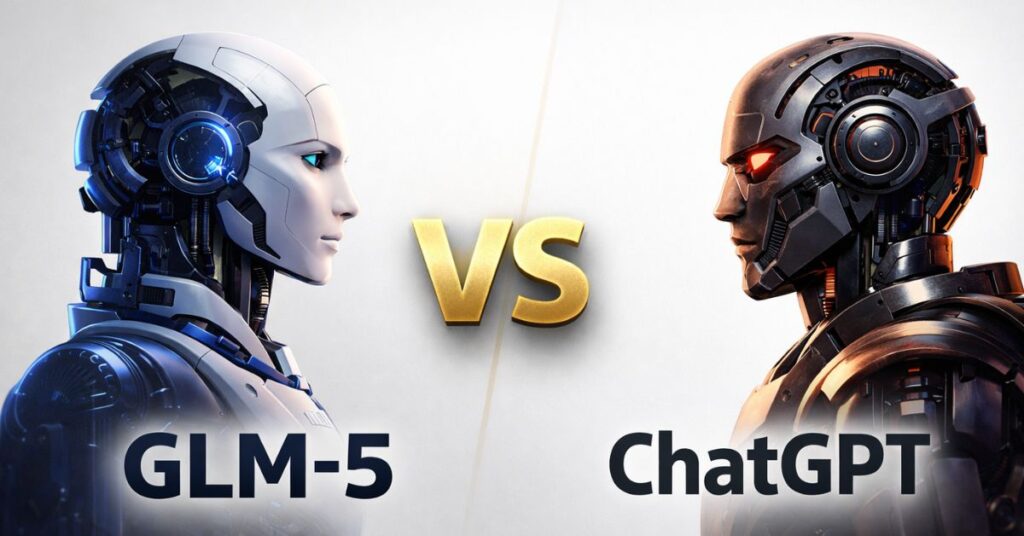
GLM 5 AI and ChatGPT are both advanced AI models, but they are designed for different needs. GLM‑5 is open-source, allowing developers to customize and self-host it, making it cost-effective for coding, research, and long-document tasks. ChatGPT, on the other hand, is proprietary, accessed through OpenAI’s platform, offering a polished experience but with limited customization.
A key difference is how much information they can handle. GLM 5 can process up to 200,000 tokens in one session, which is ideal for long documents or multi-file coding projects. ChatGPT supports long inputs too, but only about 128,000 tokens, so it may struggle with extremely long or complex texts.
In terms of capabilities, GLM 5 excels at coding, logical reasoning, and handling long tasks. ChatGPT is strong in multimodal tasks like text and images, and it integrates with plugins and tools, making it versatile for general-purpose AI. ChatGPT usually performs better in math and broad reasoning tasks.
When it comes to practical use, GLM 5 is cheaper and more flexible for developers who want to self-host or customize. ChatGPT is more expensive but offers a seamless ecosystem with ready-to-use tools and a user-friendly interface. Overall, GLM‑5 is ideal for coding and long-context work, while ChatGPT is better for multimodal AI and convenience.
GLM 5 vs Claude
| Feature | GLM-5 AI | Claude AI |
|---|---|---|
| Developer | Zhipu AI | Anthropic |
| Type & Licensing | Open-source, self-hosted | Proprietary, API-based |
| Context Window | Very long (~200K tokens) | Very long (~200K+ tokens, model dependent) |
| Strengths | Coding, automation, long-document tasks | Deep reasoning, writing quality, safety |
| Performance | Strong in coding and long-context reasoning | Excellent in reasoning, structured thinking |
| Cost | More affordable, low cost per token | More expensive, premium pricing |
| Flexibility | Highly customizable | Limited customization |
| Ease of Use | Requires setup for full use | Ready-to-use and user-friendly |
| Best For | Developers, startups, custom AI solutions | Businesses, writers, research, and high-quality output |
GLM-5 AI and Claude AI are both powerful advanced language models, but they are built with different goals in mind. GLM-5, developed by Zhipu AI, is an open-source model, which means developers can freely use, modify, and even self-host it. In contrast, Claude AI, developed by Anthropic, is a proprietary model, available only through official platforms and APIs. This makes GLM-5 more flexible and cost-effective, while Claude offers a more controlled and polished experience.
When it comes to performance, both models are very close in capability. Recent benchmarks show that GLM-5 has reached near performance parity with Claude Opus models in coding and reasoning tasks. However, Claude still has a slight edge in areas like deep reasoning, structured thinking, and high-quality outputs, especially for complex or sensitive tasks. GLM-5, on the other hand, performs extremely well in coding, automation, and long-task execution, making it a strong competitor.
Another major difference is cost and efficiency. GLM-5 is powerful and significantly cheaper—sometimes up to 5–10 times lower cost per token, and can be self-hosted, which reduces long-term expenses. Claude, while more expensive, delivers highly refined responses and better consistency, which is important for enterprise use and professional applications.
GLM-5 vs Gemini
| Feature | GLM-5 AI | Gemini (Google) |
|---|---|---|
| Developer | Zhipu AI | Google DeepMind |
| Type & Licensing | Open-source (MIT), self-hosted possible | Proprietary, cloud/API-based |
| Context Window | ~200K tokens | Up to ~1M tokens (very large) (ThePromptBuddy) |
| Multimodal Support | No (text + code only) | Yes (text, image, video, audio) (ThePromptBuddy) |
| Strengths | Coding, long-context tasks, automation | Multimodal AI, reasoning, real-world applications |
| Performance | Strong in coding and agentic tasks | Leading in reasoning and multimodal benchmarks (ThePromptBuddy) |
| Cost | More affordable, low API cost | More expensive compared to GLM-5 (ThePromptBuddy) |
| Flexibility | Highly customizable (self-hosting) | Limited customization, but easy to use |
| Ecosystem | Developer-focused | Integrated with Google tools (Docs, Search, etc.) |
| Best For | Developers, startups, coding-heavy tasks | Businesses, creators, multimodal, and general AI use |
Benefits of GLM 5 AI
GLM 5 AI delivers high performance at a low cost, making it an excellent choice for developers and businesses. Being open-source, users can customize and self-host the model, giving them complete control over the data and usage. This makes it more flexible than many proprietary AI models.
Another major advantage is its extensive context-understanding capabilities, as it can process very large documents at once. This helps with tasks like research, document analysis, and handling complex projects without losing information. It also increases accuracy in long conversations and detailed workflows.
GLM-5 is highly effective for coding and technical tasks. It can generate, debug, and optimize code in multiple programming languages. This makes it a powerful tool for developers working on complex or large-scale projects.
Additionally, GLM-5 supports advanced reasoning and automation. It can simplify complex problems, plan tasks step-by-step, and assist in decision-making. This increases productivity and helps users complete tasks more quickly and efficiently.
Limitations of GLM 5 AI
GLM 5 AI has many strengths, but it also has some limitations. One major drawback is its limited multimodal support, meaning it primarily works with text and code, while some advanced AI models can handle images, audio, or video.
Another limitation is that GLM-5 can be difficult to set up and use, especially for beginners. Because it is open-source and often self-hosted, users may need technical knowledge to properly install, manage, and optimize the model.
Compared to proprietary AI tools, GLM-5 may lack a sophisticated ecosystem. It doesn’t have built-in plugins, tools, or an intuitive user interface like some other AI platforms, which may make it less convenient for general users.
Performance-wise, GLM-5 is capable of coding and long-term tasks, but it falls short of top models in terms of general reasoning, creativity, or accuracy in certain situations. This may impact results for complex or highly sensitive tasks.
Finally, running GLM-5 on your own system can require significant computing resources, especially for large-scale deployments. This can increase infrastructure costs and limit accessibility for smaller users.
Conclusion
GLM 5 AI is a promising AI model that balances performance, accessibility, and versatility. Whether you are comparing it to ChatGPT, Claude, or Gemini, it stands out with its features and beginner-friendly design. Staying informed about models like GLM 5 ensures you remain ahead in the AI revolution
Read Our Trending Articles:
Claude 4.6 Is Here: The New AI Model That Could Challenge ChatGPT
FAQs
Q1. Is GLM-5 better than ChatGPT?
Yes, GLM-5 follows standard AI safety protocols, though users should still verify outputs for critical tasks.
Q2. Is GLM-5 safe to use?
Yes, GLM-5 follows standard AI safety protocols, though users should still verify outputs for critical tasks.
Q3. Can beginners use GLM-5 AI?
Absolutely. GLM-5 is designed to be beginner-friendly, making it easy for anyone to get started with AI
Subscribe for Latest AI Tools Updates