
Artificial intelligence is changing fast. Two terms you keep hearing in 2026 are Generative AI vs Agentic AI. Most people confuse them — and that confusion can cost businesses time and money.
In this article, we explain both in plain English. No confusing jargon. No long technical paragraphs. Just clear, simple explanations with real-world examples — and a full comparison table so you know exactly which one to use.
What Is Generative AI?
Generative AI is artificial intelligence that creates new content. You give it a prompt, and it generates something — a paragraph, an image, a piece of code, or even a song.
The most famous example is ChatGPT. You ask it a question, and it writes an answer. You say, “write me an email,” and it writes it for you. That is Generative AI in action.
How Generative AI Works
Generative AI is trained on billions of pages of text, images, and code from the internet. When you give it a prompt, it predicts the most likely next words or pixels based on everything it has learned.
Think of it like a very smart autocomplete. It doesn’t truly understand your question — but it has seen so many similar questions that its answer looks almost perfect.
Real-World Examples of Generative AI in 2026
- ChatGPT — writes emails, answers questions, summarizes documents
- Google Gemini — generates text, images, and code
- Microsoft Copilot — helps write Word documents and Excel formulas
- DALL-E / Midjourney — creates images from text descriptions
- GitHub Copilot — writes code while you type
Key Takeaway: Generative AI is reactive. It waits for your prompt, does the task, and stops. It does not take any action on its own.
What Is Agentic AI?
Agentic AI is a step above. It doesn’t just respond to prompts — it pursues goals. You give it an objective, and it figures out all the steps on its own, uses different tools, and gets the job done without asking you at every stage.
For example: You tell an Agentic AI system, “Find the top 5 competitors for my business, compare their pricing, and email me a report.” You don’t guide it step by step. It searches the web, reads the pages, compares the prices, writes the report, and emails it to you — all by itself.
This loop repeats until the task is done — or until it needs your approval to continue. (For a deeper technical definition, see IBM’s official guide on Agentic AI.)
How Agentic AI Works: The 4-Step Loop
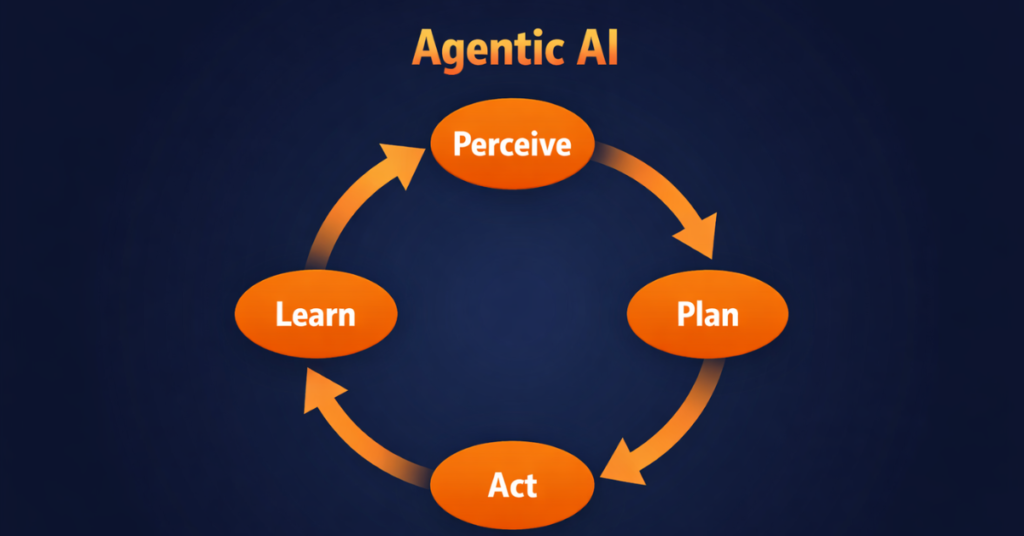
Agentic AI runs in a continuous loop with four stages:
- Perceive — It reads and understands your goal and its environment
- Plan — It breaks the goal into smaller steps
- Act — It uses tools (web, APIs, code, email) to complete each step
- Learn — It checks the result and adjusts if something went wrong
This loop repeats until the task is done — or until it needs your approval to continue.
Real-World Examples of Agentic AI in 2026
- AutoGPT — takes a goal and completes multi-step tasks automatically
- Microsoft Copilot (Agent Mode) — books meetings, manages emails, updates CRMs
- Salesforce Agentforce — handles customer support end-to-end without human help
- Devin (AI software engineer) — reads a bug report and fixes the code autonomously
Key Takeaway: Agentic AI is proactive. It takes initiative, uses tools, and completes entire workflows — not just single tasks.
Generative AI vs Agentic AI : 7 Key Differences Explained
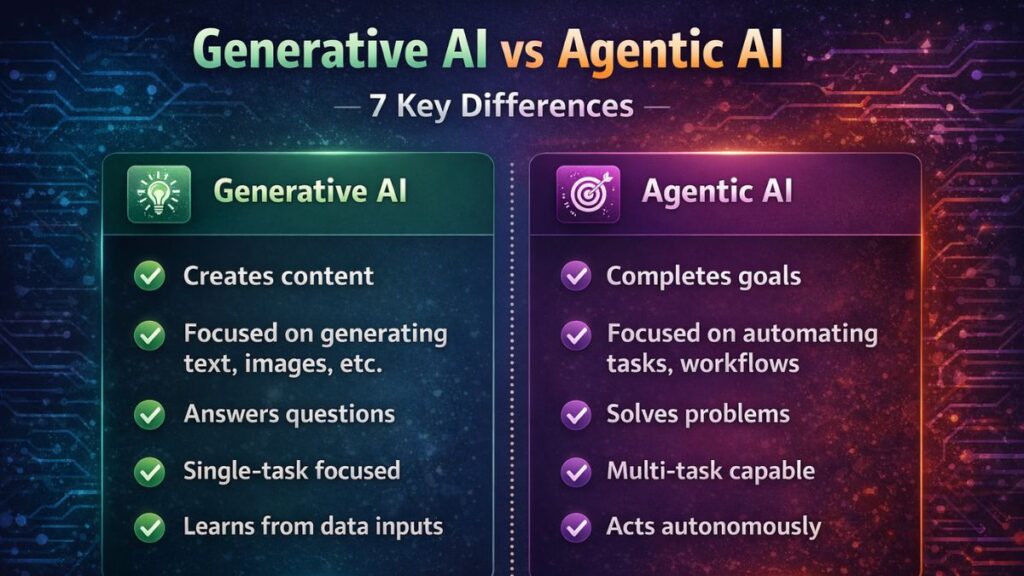
Now let’s get into the 7 differences between generative AI vs agentic AI that actually matter. Each one shows you clearly how these two types of AI behave differently in the real world.
1: Reactive vs Proactive Behavior
Generative AI is reactive. It only does something when you tell it to. Every single interaction starts with your prompt. If you stop typing, it stops working.
Agentic AI is proactive. Once you give it a goal, it keeps going on its own. It does not wait for your next message. It works in the background until the job is done.
Example: You want a market research report. With Generative AI, you must ask “search for X,” then “now compare Y,” then “now write it up.” With Agentic AI, you say “make me a market research report” — and walk away.
2: Single Task vs Multi-Step Workflows
Generative AI handles one task at a time. Each response is a separate, standalone output. It cannot chain tasks together unless you keep prompting it.
Agentic AI handles entire workflows. It chains together many steps — searching, writing, saving, sending — in one go. It works more like a project manager than a tool.
Real example: A marketing team uses Generative AI to write blog posts one by one. An Agentic AI system handles the whole content pipeline: finds trending topics, writes drafts, optimizes for SEO, and publishes — every week, automatically.
3: No Memory vs Persistent Memory
Generative AI forgets you. Please start a new chat; it won’t remember who you are or what you discussed before. Each conversation starts fresh.
Agentic AI remembers. It stores context over time — your preferences, past decisions, previous results. It learns from every interaction and applies that knowledge in the future.
This is huge for businesses. An Agentic AI customer service system remembers that a customer had a problem last month. A Generative AI chatbot does not — unless you paste the history in manually every time.
4: Output Only vs Tool Usage
Generative AI only produces text, images, or code. It cannot actually do anything in the outside world. Send an email. It cannot save a file. cannot browse a website unless you connect it to extra tools manually.
Agentic AI uses real tools. It can browse the web, run Python code, send emails, update spreadsheets, call APIs, and interact with other software — all on its own.
Think of Generative AI as a brain in a jar — very smart, but can’t move. Agentic AI has hands and legs. It can actually go out and do things.
5: Human-Directed vs Goal-Directed Autonomy
Here is the best analogy to understand this difference:
Generative AI is like a skilled intern. Smart, helpful, but needs clear instructions for every task.
Agentic AI is like a project manager. You tell them the end goal, and they figure out everything in between — only coming back when they need your approval on something big.
With Generative AI, you are always the director. With Agentic AI, you set the direction and it manages itself.
6: Cost and Speed — Which Is Cheaper to Run?
This is the difference nobody talks about — but it matters a lot for businesses.
Generative AI is fast and cheap per task. One prompt, one response. The cost is low because it only runs the model once.
Agentic AI is slower and more expensive per workflow. Because it runs in loops — checking, re-checking, using multiple tools — it uses more computing power. A single agentic task can cost 10x as much as a single generative prompt.
However, Agentic AI replaces hours of human work. A McKinsey report estimates that AI could add $2.6 to $4.4 trillion in annual value across industries — and agentic workflows are a major driver of that figure. The ROI is much higher for complex tasks. The key is to use each type for the right job — which we cover in the decision guide below.
7: Error Rate and Risk in 2026
Generative AI errors are contained. If it gives you a wrong answer, you see it immediately. You can correct it before anything goes wrong in the real world.
Agentic AI errors can cascade. If it misunderstands a goal early in a workflow, that mistake can multiply — triggering wrong actions, sending wrong emails, or making wrong API calls before anyone notices.
This is why human oversight checkpoints are essential in Agentic AI systems — especially for tasks involving money, customer data, or external communications.
Generative AI vs Agentic AI : Comparison Table
Here is the complete generative AI vs agentic AI comparison in one table:
| Factor | Generative AI | Agentic AI |
|---|---|---|
| Main Purpose | Create content on demand | Complete goals autonomously |
| Behavior | Reactive — waits for prompts | Proactive — works independently |
| Task Type | Single tasks only | Multi-step workflows |
| Memory | No memory between chats | Persistent memory over time |
| Tool Usage | Output only (text/image/code) | Uses web, APIs, email, code |
| Human Control | You direct every step | You set the goal; it manages itself |
| Cost Per Task | Low — one model call | Higher — multiple loops & tools |
| Speed | Very fast (seconds) | Slower (minutes to hours) |
| Error Risk | Low — errors visible instantly | Higher — errors can cascade |
| Best For | Writing, design, coding help | Business automation, workflows |
| 2026 Examples | ChatGPT, Gemini, Copilot | AutoGPT, Devin, Agentforce |
| Status in 2026 | Mature, widely deployed | Rapidly growing, entering enterprise |
Related Articles: Best AI Tools 2026: ChatGPT vs Gemini vs Claude vs Perplexity (Which One Wins)
Can Generative AI vs Agentic AI Work Together?
Yes — and this is actually how most Agentic AI systems work in 2026.
Agentic AI uses Generative AI as its “thinking engine.” The agent handles the planning, memory, and tool use. But when it needs to write something — a report, an email, a code snippet — it calls a Generative AI model to do that creative work.
How Agentic AI Uses Generative AI as Its Brain
Think of it this way: the Generative AI model (like GPT-5 or Claude) is the brain inside the agent. The agent framework is the body that gives the brain hands, legs, and memory.
Without Generative AI, an Agentic AI system would have no language understanding. Without the agentic framework, Generative AI would have no ability to take real-world action. They are not competitors. They are partners.
Real Example: Combining Both in a Content Marketing Workflow
- Agent detects trending topics (tool usage — web browsing)
- Agent plans 5 blog posts for the week (planning)
- Generative AI writes each post (content creation)
- Agent checks each post for SEO score (tool usage — SEO API)
- Agent publishes approved posts to WordPress (tool usage — CMS API)
- Email the weekly report to the marketing manager (tool usage — email)
The human only reviews the final report. The entire process runs automatically every week.
Which One Should You Use? (Decision Guide for 2026)
The answer depends on your task. Here is a simple guide:
Use Generative AI When…
- You need to create content quickly — blog posts, emails, captions
- You want help understanding a complex topic
- need to write or review code
- Your budget is limited — generative tools are cheaper
- The task is creative and you want to stay in control
Best tools: ChatGPT, Claude, Gemini, GitHub Copilot
Use Agentic AI When…
- You want to automate an entire workflow — not just one step
- need AI to use external tools like email or databases
- You are handling repetitive, high-volume processes
- You want the AI to monitor something and act when needed
- ROI justifies higher running costs — complex tasks save many hours
Best tools: AutoGPT, Copilot Agent Mode, Agentforce, Devin
Simple rule: If you are happy to stay in the loop for every step, use Generative AI. If you want to hand off an entire job and check the result, use Agentic AI.
Frequently Asked Questions
Q1: Is ChatGPT generative AI vs agentic AI?
ChatGPT is primarily Generative AI. However, in 2026, its newer versions with “Operator” mode and connected tools show some agentic features. But at its core, standard ChatGPT is still reactive — it responds to your prompts and stops. Full agentic behavior requires separate agent frameworks built on top of models like ChatGPT.
Q2: Is agentic AI better than generative AI?
Neither is “better” — they serve different purposes. Generative AI is better for fast, creative, single tasks. Agentic AI is better for complex, multi-step automation. Most businesses in 2026 use both together for best results.
Q3: What are the main risks of agentic AI in 2026?
The main risks are: (1) Cascading errors — a wrong decision early can trigger many wrong actions later. (2) Security risks — agents with access to email and APIs can be exploited. (3) Unexpected behavior — agents given vague goals sometimes pursue them in surprising ways.
Q4: Will agentic AI replace generative AI?
No. Agentic AI depends on Generative AI — it uses generative models as its reasoning and language engine. The two technologies are complementary. In 2026, the shift from pure generative to agentic workflows is accelerating — but both will coexist for years to come.
Q5: How much does agentic AI cost vs generative AI?
Generative AI costs a fraction of a cent per prompt. Agentic AI workflows can cost anywhere from $0.10 to several dollars per task, depending on how many steps and tool calls are involved. However, when an agentic workflow replaces 4 hours of human work, the ROI is still very strong. Many businesses report 40–60% cost savings on repetitive processes after deploying agentic systems.
Final Summary
Here is everything you need to remember about generative AI vs agentic AI:
- Generative AI creates. Agentic AI acts.
- Generative AI waits for prompts. Agentic AI pursues goals on its own.
- Generative AI handles single tasks. Agentic AI handles full workflows.
- Generative AI is cheaper and faster per task. Agentic AI is more powerful but costs more.
- Generative AI errors are visible immediately. Agentic AI errors can multiply before you catch them.
- Both technologies work best together — Agentic AI uses Generative AI as its brain.
In 2026, the most successful companies are not choosing between Generative AI vs Agentic AI. They are using both — Generative AI for creative tasks and Agentic AI for automation.
If you are new to AI, start with Generative AI tools like ChatGPT or Gemini. Get comfortable. Then explore agentic frameworks when you are ready to automate entire processes. Understanding generative AI vs agentic AI is the first step to making smarter AI decisions in 2026.