On Tuesday, March 24, 2026, OpenAI made a stunning announcement — sora shutdown, its flagship AI video generation app, is shutting down. Launched just six months ago with massive hype, the app became a viral hit before crashing just as fast. This is the complete story of how it all happened.
- What is the Sora Shutdown? The Announcement
- THE COMPLETE TIMELINE: FROM LAUNCH TO SHUTDOWN
- THE DISNEY DEAL: A $1 BILLION PARTNERSHIP THAT NEVER WAS
- Sora Shutdown: Why Did OpenAI Kill Its Own App?
- THE DEEPFAKE PROBLEM: SORA DARKER SIDE
- WHAT SORA USERS SHOULD DO RIGHT NOW
- WHO FILLS THE VOID? THE AI VIDEO LANDSCAPE AFTER SORA
- THE BIGGER PICTURE: WHAT SORA'S FAILURE TELLS US
- FINAL VERDICT
- FAQs
What is the Sora Shutdown? The Announcement
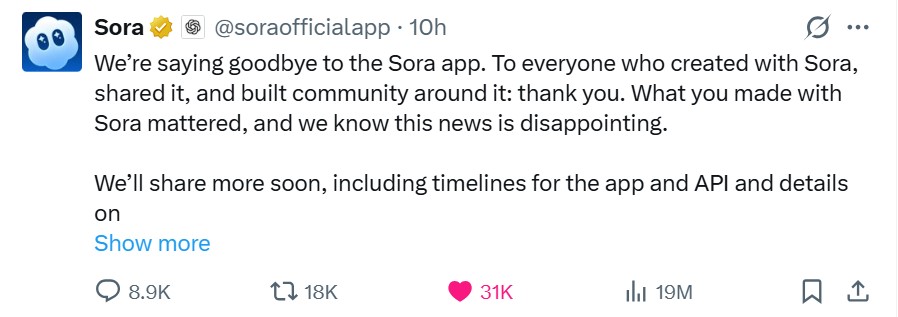
The news broke on March 24, 2026, when OpenAI official Sora account posted a farewell message on X (formerly Twitter). The post was brief and emotional:
“We’re saying goodbye to Sora. Thank you to everyone who created with Sora, shared it, and built a community around it. Everything you created with Sora mattered, and we know this news is disappointing. We’ll share more information soon, including timelines for the app and API, and details about preserving your work. – Sora Team”
OpenAI has also confirmed it will share an exact timeline for the app and API closures, along with details on how users can export and preserve their content. At this time, no official closure date has been announced.
A company spokesperson elaborated, saying, “As computing demands grow, the Sora research team will continue to focus on global simulation research to advance robotics, helping people solve real-world physical tasks.” In other words, OpenAI is pivoting from consumer social video to robotics and enterprise AI.
THE COMPLETE TIMELINE: FROM LAUNCH TO SHUTDOWN
- February 2024 — OpenAI first previews Sora as a text-to-video AI model. The internet goes wild. Filmmaker Tyler Perry pauses an $800 million studio expansion after seeing the technology.
- December 2024 — The first public version of Sora is released with limited, invite-only access.
- September 2025 — The Sora standalone app launches as a TikTok-style social network powered entirely by AI-generated video. It hits #1 on the Apple App Store and surpasses 1 million downloads in under 5 days — faster than ChatGPT itself.
- November 2025 — Android version launches. The app peaks at 3.3 million monthly downloads. Sora 2 is introduced with significantly improved video quality and native audio generation.
- December 2025 — Disney announces a landmark $1 billion equity deal with OpenAI, licensing 200+ characters from Disney, Marvel, Pixar, and Star Wars for use on Sora. Monthly downloads quietly begin declining.
- January 2026 — Downloads plunge 45% from peak. Deepfake controversies, moderation failures, and waning user interest accelerate the decline. The Disney deal remains unsigned.
- March 24, 2026 — OpenAI officially announces the shutdown of the Sora app. The Disney deal is canceled. Not a single dollar was ever exchanged.
THE DISNEY DEAL: A $1 BILLION PARTNERSHIP THAT NEVER WAS
Perhaps the biggest casualty of the Sora shutdown is its partnership with The Walt Disney Company. In December 2025, just three months ago, OpenAI and Disney announced a groundbreaking deal that had the entire entertainment industry buzzing.
Under the three-year licensing agreement, Sora would have been able to generate videos featuring characters from Disney, Marvel, Pixar, and Star Wars. Disney+ was also planning to add curated Sora-generated videos to its platform. Additionally, Disney had committed to a $1 billion equity stake in OpenAI, structured entirely as stock warrants.
With the Sora shutdown, that entire deal is now dead. Not a single dollar ever changed hands.
Disney responded with a statement: “We respect OpenAI’s decision to exit the video generation business and to shift its priorities elsewhere. We will continue to engage with AI platforms to find new ways to meet fans where they are while responsibly embracing new technologies that respect IP and the rights of creators.”
Sora Shutdown: Why Did OpenAI Kill Its Own App?
OpenAI’s official statement was vague, but analysts and tech journalists have pieced together a clearer picture. Here are the key factors:
- Skyrocketing compute costs: Generating high-quality AI video is enormously resource-intensive. As OpenAI’s compute demand grew for its core models, maintaining Sora became an expensive distraction it could no longer afford.
- Declining user retention: The app saw a 45% drop in downloads by January 2026 compared to its November 2025 peak. An AI-only social feed simply could not hold long-term user interest without authentic human content.
- Deepfake and moderation crisis: Despite guardrails, users easily created deepfakes of celebrities and public figures. This caused major PR crises and legal headaches that OpenAI could not resolve at scale.
- IPO preparations: The Wall Street Journal reported that OpenAI is cutting costly consumer products ahead of its planned IPO, prioritizing revenue-generating enterprise and coding tools instead.
- Strategic pivot to a Super App: OpenAI is consolidating its products — merging ChatGPT, its browser, and Codex into a single desktop super app. Sora did not fit this new strategy.
- Intense competition: Pressure from Anthropic’s Claude and Google’s Gemini on the enterprise side pushed OpenAI to focus its resources on areas where it has a clearer competitive advantage.
THE DEEPFAKE PROBLEM: SORA DARKER SIDE
From the very beginning, Sora was controversial. Its “characters” feature, which allowed users to generate hyper-realistic videos of themselves in any scenario, was quickly misused.
Despite OpenAI’s policies against generating videos of public figures without consent, users found workarounds almost immediately. Deepfakes of deceased celebrities, historical figures like Martin Luther King Jr., and even OpenAI CEO Sam Altman himself went viral. The daughters of both Martin Luther King Jr. and Robin Williams publicly asked users to stop creating AI videos of their late fathers.
Even though OpenAI added watermarks to all Sora-generated videos, third-party tools emerged almost immediately to remove them, making it nearly impossible to distinguish AI-generated deepfakes from real footage at a glance.
WHAT SORA USERS SHOULD DO RIGHT NOW
If you have been using Sora, act immediately:
- Export and download ALL your videos now — do not wait for an official shutdown date.
- Your sora.com library should remain accessible for some time, but do not rely on it permanently.
- Sora 1 Turbo is expected to remain available via API for developers, but the consumer app is ending.
- The ChatGPT app will also lose its video generation feature when the Sora shutdown takes effect.
- Watch OpenAI’s official channels closely for the exact shutdown timeline announcement.
WHO FILLS THE VOID? THE AI VIDEO LANDSCAPE AFTER SORA
With Sora stepping back, the AI video generation space reshuffles. Google’s Veo is now the most prominent major AI video model still actively deployed, though Google itself faces ongoing copyright lawsuits from Disney and other studios. Runway ML and Pika Labs continue to serve the creative community independently.
Importantly, OpenAI’s Sora research team is not being disbanded. It is being redirected toward world simulation for robotics — meaning the underlying technology lives on, just repurposed for industrial and scientific applications rather than social media.
THE BIGGER PICTURE: WHAT SORA’S FAILURE TELLS US
Hype does not equal retention. Sora’s viral launch was genuinely extraordinary. But an AI-only social feed could not sustain user interest over time. People return to social platforms for human connection, creativity, and authentic stories — not purely synthetic content.
Compute costs are the hidden wall. Training and running frontier AI video models is extraordinarily expensive. As companies race to improve their most critical language and reasoning models, consumer novelty products become impossible to justify when resources are scarce.
Moderation at AI scale is still an unsolved problem. OpenAI could not keep Sora’s deepfake and copyright problems under control despite significant effort. This challenge will continue to haunt every platform that allows users to generate synthetic media of real people.
Enterprise beats consumer in the current AI moment. OpenAI, Anthropic, and Google are all increasingly focused on business customers — coding tools, enterprise integrations, and productivity software. The consumer AI experiment is entering a period of consolidation.
FINAL VERDICT
Sora’s story is one of the most dramatic in recent tech history — a product that went from shocking the world, to going viral globally, to shutting down within just 18 months of its public debut. It was revolutionary technology trapped inside an unsustainable business model, a moderation crisis it could not solve, and a strategic pivot it could not survive.
For the millions of users who created with Sora, shared videos, and built communities around it — the loss is real. For the AI industry, it is a sobering reminder that impressive technology alone is never enough. You need sustainable economics, responsible deployment, and a clear reason for people to keep coming back.
Sora was a glimpse of the future. Its closure tells us that the future still has a lot of problems to solve before it arrives.
FAQs
What is the Sora shutdown
OpenAI has officially announced that it is shutting down Sora, its AI video generation app that was launched in September 2025.
When will Sora shutdown happen
No exact shutdown date has been announced yet. OpenAI has said it will share the official timeline very soon.
Was the Disney $1 billion deal also canceled
Yes — Disney’s $1 billion deal is completely canceled. The deal was never finalized, and not a single dollar was ever exchanged between Disney and OpenAI.
Will ChatGPT also lose video generation
Yes — when the Sora app shuts down, the text-to-video generation feature inside ChatGPT will also be removed completely.